


Why a Primary-Side Coolant’s Service Life Decides a Cold-Plate Hall’s Uptime
The facility loop lives outdoors and runs for a decade. Its fluid does not fail loudly. Here is how primary-side coolant ages, what ages it faster, and the few checks that keep a hall running.
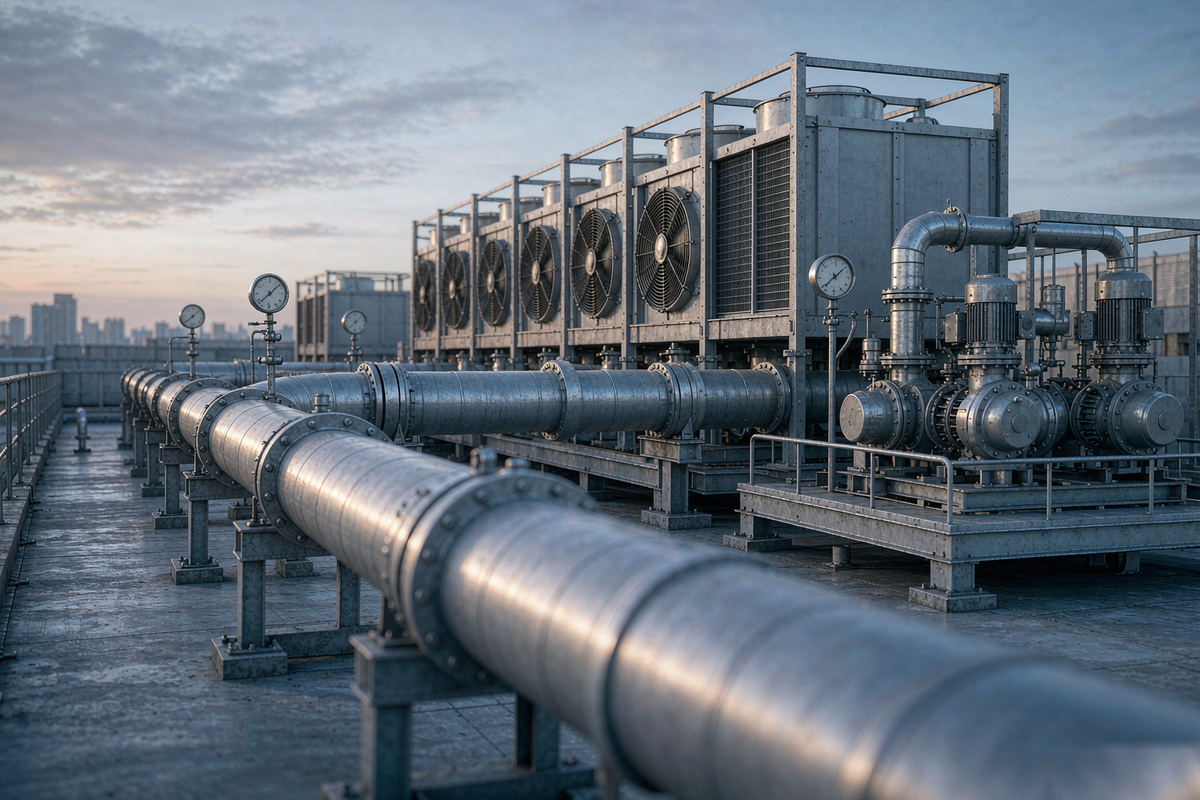
A newly filled facility loop is at its best the day it is commissioned. The concentration is exactly what the design winter asked for. The inhibitor is at full strength. Nobody has topped it up from a hose yet. Nothing about that state survives contact with a roof, but it is the state every later reading gets compared against.
That comparison is the whole discipline. At Glacier Coolant we treat primary-side service life as a maintenance subject, not a warranty date, because this loop does not fail loudly. It loses ground in a sequence, and the sequence is predictable enough to write down year by year.
Year one: the fluid you paid for
Not much happens, and that is the point. The inhibitor is doing its job across a mixed-metal circuit — carbon steel out on the roof, stainless fittings, copper in the exchangers, aluminium in some coils. The film it lays down is being consumed as it works, but there is a lot of it left.
The only thing that matters in year one is the sample. One bottle, taken at commissioning, analysed and written down. That bottle becomes the definition of healthy for this specific loop. Every later reading, on every later year, is only meaningful next to it.
Most loops skip it. The commissioning paperwork gets signed, the bottle never gets filled, and from that moment every future test result is a number floating free of any reference. You can still catch problems that way. You catch them later, and you argue about them more.
Year two to three: the first drift
Two things start moving, and both move quietly.
Concentration drifts downward. Not from a single event, usually, but from a series of small ones. A gasket weep gets tightened. A section gets drained for a valve replacement and refilled from the nearest hose. Someone adds make-up water because the level looked low. Each event adds water the fluid was not formulated around, and the freeze point climbs a little.
Oxygen also starts arriving. An open vent, a seal that weeps under pressure, a fill that was not deaerated — any of them feeds a reactant into a loop that was clean on day one. Oxygen is not a bystander in corrosion. It is one of the two inputs.
| Years | What is changing in the loop | What to look at |
|---|---|---|
| 1 | Nothing yet; inhibitor at full strength | Take the baseline sample |
| 2–3 | Concentration drifting, oxygen arriving | Concentration against design winter |
| 4–6 | Inhibitor thinning, biology establishing | Corrosion indicators, biology count |
| 7+ | Two paths split: managed or not | Trend against baseline on all three |
This is the window where a hall either installs the habit or loses it. The checks are cheap and the drift is still reversible.
Year four to six: the buffer runs thin
By now the inhibitor has done several years of work and there is measurably less of it. The rate it was consumed at depended on how much oxygen and how many impurities the loop kept admitting, which is to say it depended on site habits more than on chemistry.
This is also when biology usually establishes itself. A dead leg with low flow grows a film. The film does two kinds of damage. It fouls heat exchanger surfaces, so the loop quietly loses capacity. And it hides pitting underneath it, so the corrosion that is happening is not the corrosion you can see.
Corrosion indicators begin to move in this window. Not dramatically. A pH drifting out of its buffer window, an iron count that is no longer flat, a turbidity that has stopped being steady. Any one of them alone is unremarkable. Against a baseline, they read as a slope, and the slope is the finding.
Year seven and later: where the paths split
Two loops, filled on the same day, diverge here.
The watched one has a concentration that gets re-checked before each cold season, a corrosion trend someone reads, and a top-up discipline written on the loop rather than remembered by a person. It keeps running. Its fluid gets replaced when a trigger crosses a line, which is later than most people expect and cheaper than a calendar.
The unwatched one gets found. Usually in January, usually at a weld, often by someone who was called about something else.
The difference between those two loops is not the fluid. Both were filled with the same grade. The difference is three numbers being read against a baseline for a decade.
What shortens the decade
Most of the acceleration is site behaviour, not fluid chemistry.
Water added instead of fluid. Untreated make-up water dilutes the inhibitor and imports chloride and hardness in one action. A single careless fill can cost more than a year of ordinary service.
Air where it should not be. Open vents and weeping seals keep feeding oxygen in, and oxygen is what the corrosion reaction consumes.
Heat beyond the design band. A loop sized for one duty and pushed into another runs the fluid hotter. Heat speeds up every ageing process in the list.
Dead legs left alone. Low-flow sections grow films, and films hide pitting.
No baseline to compare against. Without that first bottle, every later reading is a guess, and guesses get postponed.
Reading the three numbers
| Signal | Healthy | Time to act |
|---|---|---|
| Concentration vs design winter | Above the freeze margin | Replenish before the cold season |
| Corrosion indicators | Steady against baseline | Investigate a drift |
| Biology count | Below the control limit | Treat before it scales |
| Turbidity | Low and steady | Find the source if it climbs |
The first row is the one that decides whether January is quiet. The freeze point has to sit below the local design winter, not the record low and not a round number someone inherited. Concentration is cheap to check and it is the check that gets skipped most often.
Where the coolant sits in the building matters here too. Where the coolant actually works in a hall lays out the three loops and why the facility loop ages differently from the one inside the rack. What to do when a liquid-cooled rack runs warm walks the diagnosis order when something has already gone wrong.
Where we come in
We analyse the sample you send and write down what healthy looks like for your loop. That is the baseline, and it is the reference for everything after.
Each later sample gets compared against it. What we report is the drift, not the absolute value, because the drift is the early warning and the absolute value is trivia without a reference.
Then we convert the drift into a trigger. Instead of “replace every N years”, you get “act when signal X crosses line Y”. A trigger is cheaper than a calendar and it does not fire on a loop that is still healthy.
We also write down the fill and top-up discipline: what may be mixed, what may not, and what to test after every fill. The cheapest failures to fix are the ones caught at the sample bottle.
FAQ
How long does data centre coolant last?
Years, with correct formulation and maintenance — but life is set by loop conditions, not a calendar date. A neglected loop ages far faster than a watched one.
When should I replace the primary side glycol?
When the trend triggers, not when a date arrives. Concentration drift, corrosion-signal movement and biology growth are the signals to act on.
What ages a facility loop fluid fastest?
Untreated water added as a top-up, oxygen entering through vents or weeping seals, and operation above the design temperature band.
Is freeze damage always a winter problem?
The freeze happens in winter, but the cause — concentration drift — builds all year. Re-checking concentration before the cold season prevents most freeze failures.
Do I need to sample the primary side as often as the cold plate loop?
Follow published equipment guidance: about every six months on high-density AI loads, about annually on general service. Test after every top-up or repair regardless of the calendar.
Can biological growth really damage the loop?
Yes. A slime mat in a dead leg hides pitting underneath it and also fouls heat exchangers. Keeping biology under the control limit is corrosion control, not housekeeping.
What does a baseline sample cost me in effort?
One bottle at commissioning. Everything you do for the next decade reads against it, so the single sample pays for itself the first time a drift gets caught early.
Who is responsible for the loop and who for the fluid?
The operator owns the loop, the seals and the make-up discipline. We own the fluid specification, the sampling analysis and the replacement trigger. The boundary is clear, and most failures sit on the loop side of it.
Starting the clock on a loop that is already five years old
Most people reading this are not at commissioning. They are standing next to a loop that has been running for years and has no baseline.
You can start anyway. Take a sample now and label it “year zero, mid-life”. It is not a commissioning baseline, but from this point forward you have a reference, and a drift over the next two samples tells you more than any single reading ever will.
At the same time, walk the loop for the four things that accelerate ageing: an open vent, a weeping seal, a dead leg, and a make-up line with no quality written against it. Those four are fixable in an afternoon. They are also the cause of most of the concentration drift that turns up in the sample.
Then check the drum store. The primary side and the cold-plate side are different jobs, and they are frequently filled from the same shelf. A primary-side loop wants freeze margin and a corrosion package sized for outdoor pipework. A cold-plate loop wants tight ion control against live hardware. Topping up the wrong one from the wrong drum imports a problem designed for the other loop’s job. Label both, and write the grade on the loop rather than only on the drum.
| Step | Effort | What it buys you |
|---|---|---|
| Sample now and label it “year zero” | One bottle | A reference for every later reading |
| Walk the loop for the four accelerators | An afternoon | Removes the drift sources you can see |
| Label the drum store by loop | An hour | Stops cross-top-up between two grades |
| Book the check before the cold season | One calendar entry | The freeze check that prevents January |
How ice blockage starts with water in the loop covers the failure mode that arrives when concentration is left alone. The product range lists the families by temperature band.
One last thing about January
A facility loop that fails in January did not fail in January. It failed across a decade of small decisions, most of which were reasonable at the time and none of which were logged.
The hall that reads three numbers against a baseline does not avoid every problem. It just meets them as a slope on a chart instead of a call on a cold morning.
Glacier Coolant builds heat-transfer fluids for the circulating loops that sit between the machine and the point of use — including the outdoor primary side that most halls forget is there. Send us a sample from your primary side. We will return a baseline, a trend against it, and a replacement trigger you can put on the dashboard.
Post time: Oct-21-2026