


Immersion Cooling Across Server, Edge and High-Density Racks: Picking the Right Fluid Band
Immersion is not one fluid. High-density compute, wide-temperature edge duty and cost-sensitive storage each ask for a different immersion grade. How to match the band to the box.
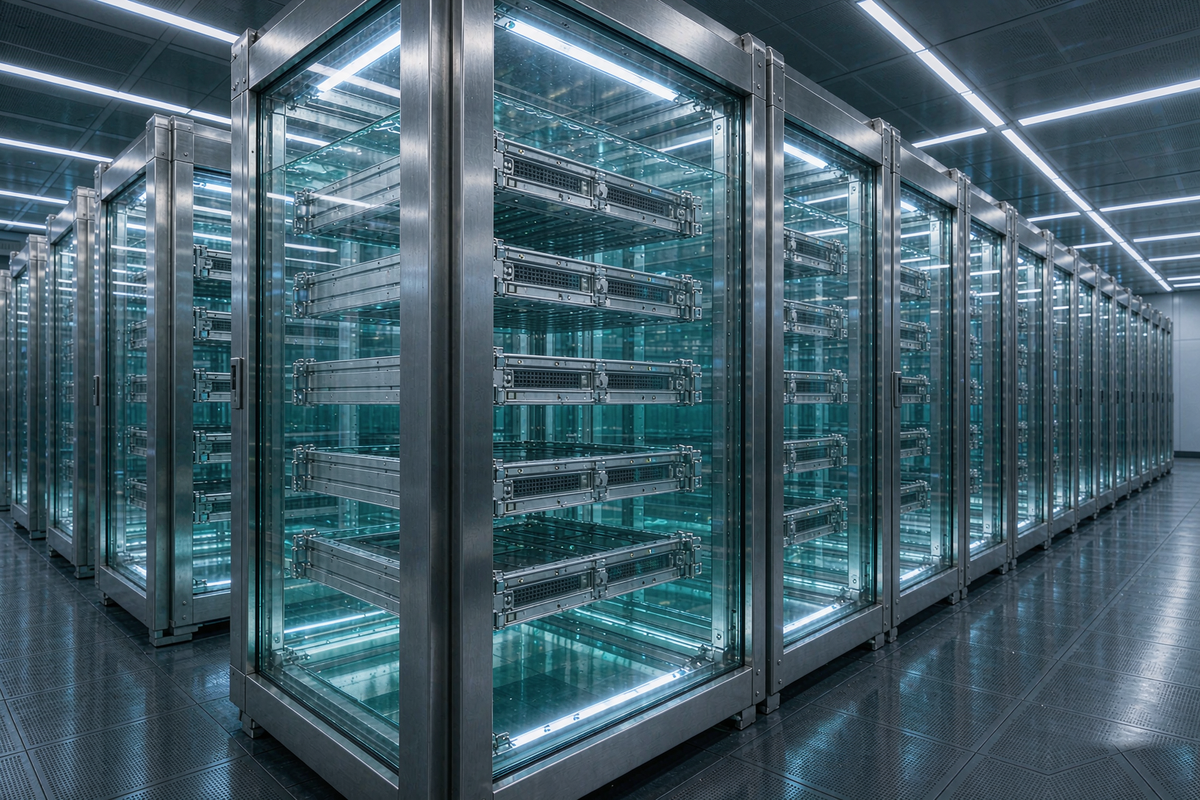
“Immersion cooling” is one word covering three jobs. A megawatt AI rack, a roadside 5G cabinet and a storage enclosure full of battery modules do not ask the same thing of the fluid they sit in.
So this is not a comparison chart. It is four questions. Answer them in order and the band picks itself.
At Glacier Coolant we sort immersion duty into bands, because the grade that suits a high-density compute hall is the wrong grade for a wide-temperature edge site, and both are wrong for a cost-sensitive storage rollout. The trap is buying “an immersion fluid” as though it were one product.
The four questions
| # | Question | What the answer narrows |
|---|---|---|
| 1 | Is the enclosure sealed, indoors, dust-controlled? | Whether you buy for stability or for weather |
| 2 | What temperature swing does the site see? | The operating window the grade must hold |
| 3 | What does the fluid actually touch? | The compatibility list to check |
| 4 | Who owns the electrical specification? | Where the dielectric question belongs |
Answer honestly and you land in one of three places. Most expensive mismatches happen because question one was answered from the brochure rather than from the site.
Question one: is the enclosure actually sealed?
Not “is it specified as sealed”. Is it?
Sealed, indoor, filtered, opened on a schedule. You are buying for stability. Oxidation is the dominant ageing path, and the fluid’s job is to hold its properties for years rather than to survive weather. Carry “compute” into question two.
Outdoor, roadside, mobile, or opened whenever someone needs access. You are buying for range. Deep cold and high heat will both arrive, usually with dust, salt and moisture alongside. Carry “edge” into question two, and expect the temperature window to dominate everything after it.
A large indoor rollout where cost per cabinet matters more than peak margin. You are already in the storage band. Skip to question three.
This first answer carries more weight than the other three combined. It is also the one most often skipped, because it is the only one that requires walking out to the site.
Question two: what is the temperature swing?
Write down the lowest and highest fluid temperature the enclosure will see. Not the air temperature around it, and not the nameplate rating of the hardware.
A roadside cabinet in a continental winter sees a span that a data hall never will, and a grade chosen for the hall will be outside its window at one end of that span. This is not a margin question. A fluid outside its operating window is not slightly worse. It is the wrong fluid.
The wide-temperature band exists precisely for this: a grade built to stay stable across a very large swing, from deep cold to high heat, so it keeps carrying heat at both ends rather than failing at one. The generalist trades the peak margin of the compute grade for breadth, and breadth is exactly what an outdoor or mobile enclosure needs.
A compute hall is the opposite case. Its temperature is controlled, its swing is narrow, and what it needs is not breadth but endurance: a fluid that holds its properties through years of continuous, load-heavy duty inside a sealed box.
There is a version of this question that catches people out. A site can be indoors and still see a wide swing, if the enclosure sits near a loading bay, an unconditioned plant room, or anywhere the ambient follows the weather rather than the setpoint. Indoor does not automatically mean controlled, and the enclosure’s location inside the building is often more decisive than the building’s climate class.
So measure the fluid temperature, or measure the air right at the enclosure, rather than reading the hall’s design setpoint off a drawing. The drawing describes the room. Question two is about the box.
Question three: what does the fluid touch?
Immersion is the only cooling arrangement where the fluid meets the whole inside of the enclosure.
| Inside the tank | Why it has to be named |
|---|---|
| Copper and brass | Dissolved copper catalyses further oxidation |
| Aluminium | pH drift invites pitting under a film |
| Solder | Selective attack leaves joints mechanically weak |
| Cable polymers | Swelling or embrittlement changes bend radius |
| Conformal coating | Lifting exposes tracks to the fluid |
| Lid gasket | The seal is a wetted material too |
Ask for this list on the quote, named the way your hardware is actually built. “Compatible with common materials” is not a list, and a supplier who cannot produce one has not checked.
This question rarely changes which band you are in. It changes which grade within the band is safe to buy, and it is the question that most often gets answered last.
Question four: who owns the electrical specification?
This one has a single answer, and it is not us.
We do not publish dielectric strength or breakdown voltage for immersion fluids, and we make no insulation claims. That property is set by the equipment maker’s material specification for the enclosed system. It belongs to the hardware designer, who knows the clearances, the coatings and the board layout.
A fluid supplier who hands you an insulation number should make you suspicious rather than reassured. What we will give you instead is the fluid-side information your own electrical review needs: how the properties hold over the service life, which materials are compatible, and what the fluid does as it ages.
Where your answers put you
| Your answers | Band | What the grade is built for |
|---|---|---|
| Sealed hall, narrow swing, continuous load | High-density compute | Stability over years, sealed operation |
| Outdoor or mobile, wide swing, weather | Wide-temperature edge | Holding properties across the full range |
| Large indoor rollout, cost-led | Cost-sensitive storage | Rare change-outs, safe handling |
A single fluid can sit in more than one band. It rarely sits in all three well. The grade that wins at the edge is not the grade that wins in the hall.
Two projects that look the same on paper
A 200-cabinet storage rollout and a 200-cabinet compute rollout. Same cabinet count, same fluid volume, same procurement process.
The storage one should be buying for the replacement cycle. Its fluid sits at moderate temperatures, does not need a wide window, and its saving comes from holding properties long enough that nobody drains it for years. Paying for range it will never use is an overspend with no return.
The compute one should be buying for endurance. Its temperature is controlled, so range is irrelevant, and what it cannot afford is a fluid that drifts over a long continuous duty and forces a change-out across a live hall. The change-out, not the fluid, is the expensive line.
Buy these two the other way round and both fail. The storage rollout pays for margin it does not need. The compute hall gets breadth instead of endurance, and discovers the difference at year three.
Neither mistake looks like a mistake on the purchase order. Both look like a fluid problem later, and neither is one.
The reason they are so hard to spot is that both fluids work on day one. A compute grade in an outdoor cabinet cools perfectly well until the first winter. An edge grade in a sealed hall cools perfectly well until year three, when the change-out arrives early and nobody can explain why. Mismatched bands do not fail at commissioning. They fail on a schedule that has nothing to do with the commissioning report.
FAQ
Which fluid is best for immersion cooling?
The one matched to your duty band — high-density compute, wide-temperature edge, or cost-sensitive storage. The three bands trade stability, range and cost against each other.
Is one immersion coolant enough for all scenarios?
Usually not. A compute fluid, a wide-temperature edge fluid and a cost-sensitive storage fluid each optimise a different property, and one grade rarely serves all three well.
What immersion fluid suits edge and EV battery duty?
A wide-temperature grade built for a large operating window, designed for outdoor and mobile exposure rather than for peak compute endurance.
Do you publish dielectric strength for immersion fluids?
No. We publish neither dielectric strength nor breakdown voltage, and we make no insulation claims. That property is set by the equipment maker’s material specification.
Why can you state flash point but not dielectric strength?
Flash point is a fluid property that sits on the nameplate. Dielectric strength and insulation are properties of the whole enclosed system, and belong to the hardware designer.
How does the cost-sensitive band actually save money?
Mainly by holding its properties so change-outs stay rare. That avoids the recurring labour, downtime and disposal cost that an ageing fluid imposes on a large rollout.
Can a single grade cover servers and storage?
A broad-temperature, oxidation-resistant grade can span a wide duty. But the enclosure type and operating temperature should still be matched before specification, not assumed afterwards.
What is the most common band mistake?
Buying for the wrong enclosure. A compute grade in an outdoor cabinet spends margin nobody needed, and an edge grade in a sealed hall lacks the endurance that mattered.
The band you should have started from
Every one of these mismatches is visible at the point of purchase and invisible on the purchase order. The fix is to answer the four questions before looking at a single product page.
The eight questions that stall a coolant decision covers the ones that come earlier still. How to choose a secondary refrigerant by temperature does the same job for the loops outside the tank. The product range lists the immersion families by band.
Glacier Coolant builds immersion fluids for compute, edge and storage duty. Send us the enclosure type, the temperature swing and the wetted materials. We will tell you which band you are in, which grade fits it, and which questions to route to your equipment maker instead.
Post time: Oct-23-2026