


Battery and Storage Immersion Cooling: What Actually Matters
Immersion cooling for batteries is sold on a dielectric number most suppliers will not show. We do not publish one either. The properties that decide field life are ion conductivity, fire class, compatibility, and volatility — the ones you can verify in your loop.
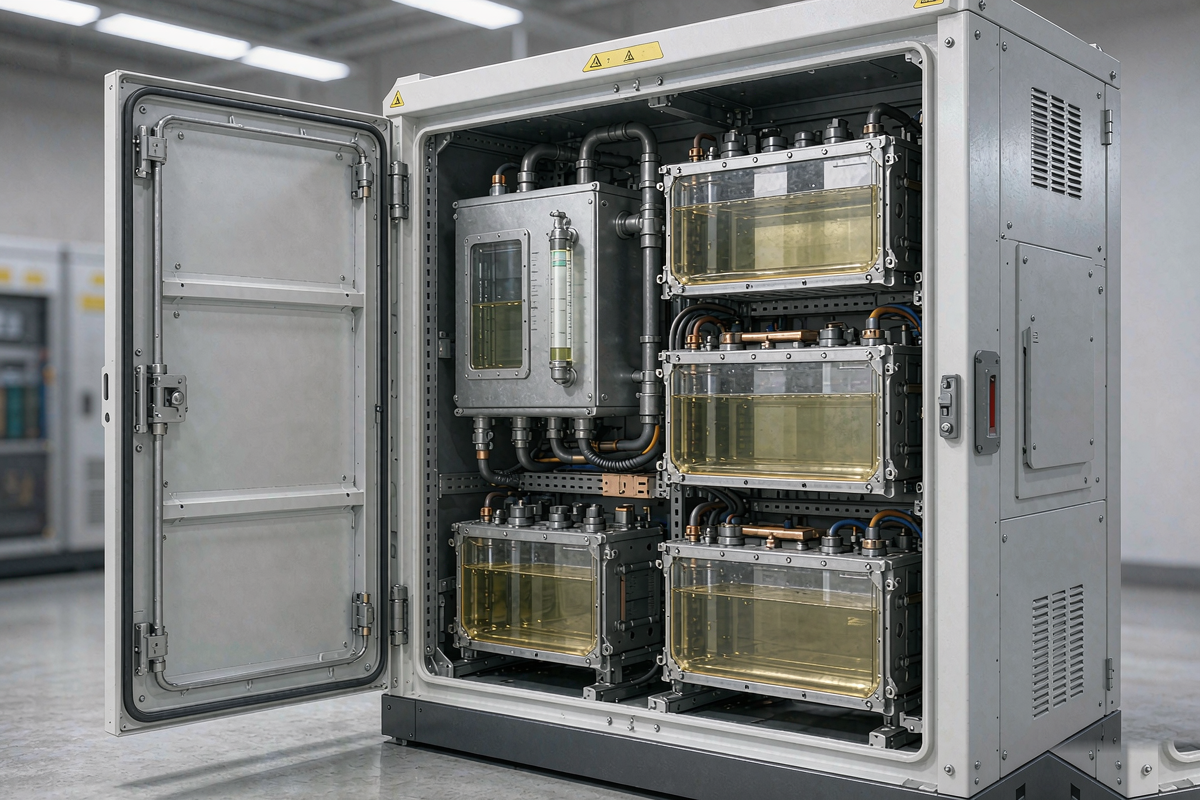
Glacier Coolant supplies heat-transfer fluids for battery and storage immersion, including low-ion-conductivity grades. This article is the buyer’s check we give before a spec is written: what to verify, what to ignore, and the one claim we will not make.
The number you cannot verify is the wrong anchor
Dielectric strength is measured on a fresh, pure sample between two plates under conditions your loop will never see. By the time the fluid has run a year with trace water and metal ions, that number has moved, and you cannot re-measure it in the tank.
What you can verify, and what protects the cells, is ion conductivity — how readily the fluid carries current in your loop. Low ion conductivity keeps a leak from becoming a fault. We publish that figure. We do not publish a dielectric strength figure, and we advise buyers to ask for the one they can track. The discipline is the same one we lay out in the heat-transfer fluid testing routine: track the number that moves, not the one that looked good on arrival.
| Claim | Where it is measured | Can you re-check it in service? |
|---|---|---|
| Dielectric strength | Fresh sample, two plates, lab | No — the tank is not the rig |
| Ion conductivity | Your loop, your sample | Yes — send a draw and read it |
The table is the whole argument in two rows. One number is a lab event you cannot repeat. The other is a loop reading you can take any week you doubt it.
What matters in the field
Strip the marketing and four properties decide whether an immersion fluid earns its place.
| Property | What it protects |
|---|---|
| Low ion conductivity | Keeps a leak from carrying current to the cells |
| Fire class | Limits what a thermal event becomes |
| Material compatibility | Holds the seals, metals, and polymers in the pack |
| Volatility | Limits what escapes and what condenses elsewhere |
None of these is a dielectric number. All of them are things you can check in your own loop, on your own schedule, with your own sample. That is the difference between a claim and a control.
The fire class is not a footnote
A battery pack is a fire risk by design, and the fluid around the cells is part of that risk. A non-combustible grade with no flash point limits what a thermal event becomes. The fluid will not add fuel to it.
For storage at scale, that class is the property operators ask about first, and rightly. A fluid that burns changes a contained event into a spreading one. We rate our immersion grades on flash point and combustibility, not on a number that says nothing about fire. When a site holds several gigawatt-hours of cells, the question is never whether a fluid is efficient. It is whether the fluid stays inert while those cells do what they do. That is the property we put on the nameplate, because that is the property the site lives with.
Material compatibility is where packs fail
The cells sit in a housing full of seals, metals, and polymers the fluid touches for years. A grade can read inert on paper and still turn aggressive in the pack. It will swell a seal or pit a contact long before any thermal event shows up.
We qualify immersion grades against the materials in the pack, not against a generic inert label. The compatibility list is the document we hand with the fluid, because the pack is where the fluid lives, and the pack is what fails if the list is wrong. A buyer should ask for that list by part number, not by a vague inert claim, because two seals that look the same on paper can age very differently in the same bath.
Volatility and what escapes
An immersion fluid that volatilises leaves the bath. It condenses somewhere else — on a connector, in a vent, on a surface it was not meant to reach. Low volatility keeps the fluid in the bath and out of the places it can do harm. We have seen packs where the only early sign was a film on a connector no one expected the coolant to reach.
This is a property buyers under-weight, because it shows up slowly. A fluid that holds its band without escaping is the one that still looks the same at year three, and year three is when most pack problems surface. A site that opens a pack at year three and finds the bath unchanged has bought more than a fluid. It has bought a quiet maintenance calendar.
What we will not claim
To be plain about our own limits: we do not publish a dielectric strength or a dielectric constant for these fluids, and we will not. Low ion conductivity is the claim we stand behind. It is the property you can measure in your loop, and the one that decides whether a leak carries current.
A supplier who leads with a dielectric number and cannot show you ion conductivity is asking you to trust a figure you cannot track. Ask for the trackable one. Our note on semiconductor process cooling covers the same discipline on a different duty.
The grade attributes for immersion
| Attribute | Why the pack needs it |
|---|---|
| Low ion conductivity | A leak stays a leak, not a fault |
| Non-combustible class | A thermal event stays contained |
| Material-qualified | Seals and contacts survive the years |
| Low volatility | Fluid stays in the bath |
| Long-term stable | Looks the same at year three |
No single attribute is the story. The pack needs all five at once, because a pack fails on the first one that slips.
The one question to open with
Open the spec conversation with one question: what can you measure in my loop, and will you show it? The supplier who answers with ion conductivity, fire class, a material list, and volatility is handing you controls. The one who answers with a dielectric number and a silence is handing you a claim.
That question sorts the field faster than any datasheet. The properties you can track are the properties that protect the pack. The supplier who leads with those is building for your loop, not for a brochure.
A grid-scale duty, stated plainly
To make the point concrete without naming a client: we support a grid-storage site that holds several gigawatt-hours of cells, cooled by immersion. The spec conversation there never opened with dielectric strength. It opened with combustibility, because the operator’s first question was what the fluid does while thousands of cells cycle next to it.
The grade that went in was qualified on flash point, ion conductivity, and the pack’s own seal and polymer list. None of that is a number you read once and forget. It is a set of readings the operator can take again after a year, and that is the whole reason the duty is safe to run. A brochure number would have told them nothing they could check on site. The cells do not care what the datasheet said in year one; they care what the fluid still is in year three.
FAQ
Do I need a dielectric fluid for battery immersion?
You need a fluid that will not carry current in your loop. Low ion conductivity is the property that delivers that, and it is the one you can measure in the tank.
Why don’t you publish a dielectric strength number?
Because it is measured on a fresh sample under conditions your loop never sees, and you cannot re-check it in service. We publish ion conductivity, which you can track.
What matters more than dielectric strength?
Ion conductivity, fire class, material compatibility, and volatility. Those are the properties your pack actually lives with, and all are checkable in your loop.
Is a non-combustible fluid important for storage?
Yes. A fluid that does not burn limits what a thermal event becomes. For storage at scale, the fire class is often the first property operators specify.
How do I check compatibility with my pack?
Ask the supplier for a material qualification list against your seals, metals, and polymers. We hand that list with the fluid, because the pack is where the fluid lives.
What does volatility do over time?
A volatile fluid leaves the bath and condenses on connectors and vents. Low volatility keeps it in the bath and out of the places it can harm.
Can one fluid cool both cells and electronics?
Sometimes, if the grade spans the duty and the materials match. Send the pack materials and the temperature band; we name the grade and the reason.
How do I specify an immersion coolant?
Ask for ion conductivity, fire class, a material list, and volatility — not a dielectric figure. Our glycol-versus-engineered view covers the grade decision.
Final thoughts
Battery and storage immersion is decided by the properties your loop lives with. Ion conductivity, fire class, compatibility, volatility — not a dielectric number you cannot verify in service. Lead with the trackable ones, and ask any supplier for the same.
Send us your pack materials and temperature band. Glacier Coolant will return a grade qualified against your list, and the ion-conductivity figure you can track, not a dielectric claim you cannot.
Post time: Oct-16-2026